Thursday, October 16, 2014

Less-Than-Wonderful Things about Cochabamba

While most of Cochabamba is wonderful, to present a truly honest picture of it, I need to mention a few less awesome details.  Here are my least favorite things about the city:

1. Germs

There are so many germs here.  The tap water is full of bacteria and amebas, so everyone coming from other countries has to boil it before drinking it.  This is kind of a pain, but wouldn't be so bad, except that people here drink it and use it without problems.  This means foreigners have to be really careful about food here - I can't eat fresh fruits and vegetables, for example, because they're washed in tap water (I miss salads so much!).

Picture of giant cow tongues borrowed from
https://c2.staticflickr.com/8/7082/6945822754_c7a254c515_z.jpg
There are also very questionable food safety practices throughout the city.  In the markets, for example, unrefrigerated, uncovered raw meat just sits on counters until someone buys it, and even bread comes in wheelbarrows with flies buzzing around them.  There are tons of street vendors selling roasted meat and empanadas and ice cream all over the city, but no one seems to have a reliable way to keep food at the right temperature (or to wash their hands).

It gets even worse, though, if you're working at an under-resourced orphanage, where none of the bathrooms have soap, fruits and vegetables are stored on the floor underneath the stairs, and all of the girls have lice.  I think, all things considered, I've been pretty healthy, but for a hypochondriac like me, it's been a little tough to adjust.  And I got lice for the first time in my life at age 24.  On the plus side, when I get back to the US, I should have an immune system of steal.

2. Terrible Internet

It is almost impossible to find good internet here.  Apparently, every company you can buy internet from in Cochabamba actually contracts it back to the same provider - and that provider is terrible.  Every once in awhile you'll luck out and get decent speeds for a few minutes, but no matter where you go, the internet is constantly going out or slowing way down.  It's not that big a deal most of the time, but it makes it super frustrating to Skype and FaceTime with people from home.  There are a million free ways to talk online, but the only way I can talk to anyone for longer than five minutes at a time is to pay to use an international call booth.

I didn't take a picture of the actual scorpion,
so this is borrowed from http://4.bp.
blogspot.com/-lAKrQJMoLHQ/
ToXWtJgUixI/AAAAAAAABlM/
puKOgOBUtfc/s1600/escorpion.jpg
3. Scorpions

I have never lived in a place with scorpions.  I had no idea there were scorpions in Bolivia.  Then one night, about two weeks after I arrived, I walked over to the sink to wash a dish - and there was a little scorpion crawling around inside it!  Everyone I have asked says that they are pretty rare, so I keep telling myself they are not a huge threat, but I still hate them.

4. Laundry

We do not have a clothes washer here.  We have a big pot and a sink.  So, once a week on laundry day, I fill up the pot with laundry detergent and boiling water, and do my best to scrub my clothes with a little brush before rinsing them out on the other side of the sink.  It's not that bad for things like shirts, but washing jeans or sweaters or sheets is a mess, and the whole process takes about two hours.  Maybe I'll get better at it as time goes on, but for now, it is my least favorite chore.

Two hours of this every week

5. No Chipotle

Not even a three hour's drive away in Tallahassee.  

And...that's all I can think of.  As I said, it's a wonderful city overall.  I just wish there was a little more soap.

Sunday, October 12, 2014

Presidential Elections

Today is Election Day in Bolivia!  It's pretty exciting - way more involved than election days in the U.S.

For one thing, voting is mandatory here.  Every person over the age of 18 has to vote; otherwise, they aren't allowed to leave the country for the next year and lose the right to vote in the next election.  The headline of the paper today is "6.2 Million Bolivians Elect New Authorities" - they know how many people are going to vote even before it happens.

There are a lot of other rules that take place this weekend.  Alcohol sales have been banned since Friday - I guess the government wants everyone to be in their most sensible state of mind for today.  Also, for all of today, cars are completely banned.  The streets are deserted except for people walking on foot or biking, and most things are closed for the day.  Supposedly, this is to prevent corruption - you can't sneak extra votes into ballot boxes if you don't have a car to do so.

This is the infographic from the paper today, describing the actual voting process.  It seems pretty intense - it involves a "president of the voting table" signing your ballot, and you stamping it with your thumb and signing it.  Not the most anonymous, but maybe it helps cut down on fraud?

There is a bit of controversy surrounding this particular election.  In Bolivia, presidents are limited to 2 terms, and those terms can't be consecutive.  The current president, Evo Morales, has already had two terms.  During this past one, however, the government re-founded the country, writing a new constitution and renaming it (from "República de Bolivia" to "Estado Plurinacional de Bolivia").  Because of this, he's saying he's only been president of this country for one term, and he's running again.  As the first indigenous president in South America, and as someone who's helped the economy and done a lot of good for the poor and indigenous people in Bolivia, he's generally popular and is expected to win by a good margin - although plenty of people (especially the richer, whiter people who are concentrated in the eastern part of the country) have their reservations about him.

I'm not sure how long it takes for the authorities to collect and count all of the votes.  Everything is done on paper, and this is a country where only 20% of the roads are paved, so I imagine it takes awhile to collect and count everything.  I'll keep you guys posted, though!

Saturday, October 11, 2014

Wonderful Things about Cochabamba

1. Great People

When I first arrived in Bolivia, I literally knew no one - I had sent some emails to the volunteer coordinator, but had never met or even talked on the phone to anyone in the entire country.  For the first two weeks, I was worried that this was a huge mistake.  I had no friends and was worried that this would be the loneliest year of my life.  It turns out, though, that Cochabamba is full of approachable, friendly, and interesting people.  Bolivians seemed a little quiet at first, but almost everyone I've met has turned out to be super welcoming and warm, and it hasn't been too hard to make friends.  I also started randomly chatting with a girl I heard talking on the phone in English before a concert, and through her have met a bunch of international volunteers from England, Australia, North America, and all over Europe - all nice and interesting people doing cool things with children, micro-financing, journalism, people with disabilities, and more.  Plus, over the past two weeks, I've gotten two awesome new roommates to explore, do errands, and play German pirate-themed dice games with!

2. Beautiful Parks


In addition to being surrounded on all sides by picturesque mountains, Cochabamba is full of amazing parks and gardens.  Every few blocks, there's a plaza or square filled with flowers, trees, pathways, fountains, and playgrounds for kids.  The parks are always filled with families, couples, and groups of teenagers, and the bigger ones have kiosks with food and plastic tables set up for people to have lunch at.  Wandering through the parks here reminds me a little of summer in Minneapolis, when everyone is outside walking around the lakes - only here, park season lasts all year long and is full of beautiful tropical trees and flowers.


3. Great for Spanish

Cochabamba is a wonderful place to study Spanish.  For one thing, Bolivian Spanish is pretty neutral - it doesn't have a strong accent or a lot of slang that's used only here - so it's fairly easy for foreigners to understand and useful for talking to people all over Latin America.  It's also a great place to go to be immersed in Spanish.  There aren't many foreigners, and not a lot of people speak English.  In the Dominican Republic, everyone spoke English and, especially when I would travel to touristy areas, tons of people would use that with me.  Here, that has never happened.  Besides talking to the other international volunteers (and sometimes to one Bolivian friend who wants to practice English), every conversation I have is en español - which is awesome!

4. Perfect Size

With almost a million people in and around Cochabamba, it has plenty to do - museums, restaurants, parks, concerts, open-air markets, hiking trails, soccer games, places to dance - as well as important practical things like good doctors and an airport.  But at the same time, it's not so big that it's overwhelming.  Almost everything important is downtown (only about a 20 min walk from my apartment), and even though I've only been here a month, I rarely have trouble finding my way around.  Except for one unfortunate bus trip that accidentally took me two cities over, I haven't been lost once - impressive, as that happened all the time when I first moved to Pensacola.

This sign says "We'll make of Cochabamba an eternal spring" -
a little ironic given how cloudy it was that day, but usually true!
5. Perfect Weather

Cochabamba is nicknamed "the City of Eternal Spring" - a name it totally deserves.  Every day here is like a perfect spring day in Minnesota: temperatures in the high 70s or low 80s during the day, and in the high 40s or low 50s at night.  You can leave your windows open all the time, and, while I've learned to take a sweater with me everywhere (it gets chilly in the shade even during the day!), you never need more than that.


6. Los Gatitos
Cariño
And, finally, the newest addition to my life in Cochabamba: Cariño and Amorcita, the two adorable kittens my roommates and I just adopted.  The boys' home that we live in has a courtyard filled with animals - five dogs, three chicks, a rabbit, and a few cats.  My super sweet and animal-loving roommate had noticed two kittens who were not being taken care of.  We don't know what happened to their mom, but she's not around, and without her, the kittens were looking malnourished and helpless.  (We even saw one of them trying to nurse from one of the dogs!)  So, this weekend, we brought them up to our apartment, gave them baths and milk, took them to the vet, and settled them in with a bed (a desk drawer filled with blankets).  They seem to be much more relaxed than they were downstairs, and have even started batting around pieces of string and climbing up into our laps.  They are the most adorable little animals I have ever seen.

Amorcita
So, overall, Cochabamba is wonderful, but stay tuned for the next post, when we explore its less-charming side.

Friday, October 3, 2014

More Food

Here are a few of the best, worst, and most interesting Bolivian foods I've tried so far:

Chuño


In both of these pictures, the dark brownish things that look like chunks of meat are actually pieces of chuño - freeze-dried potatoes.  Chuño has been made for hundreds of years in the mountains of Bolivia and Peru by letting potatoes sit outside in freezing temperatures at night and then putting them in the sun during the day.  It's a good way to preserve potatoes until you want to boil them in a soup or stew.  It doesn't taste at all like a potato - it's more like eating a slightly nutty sponge.  It's not terrible, but I don't think I'll be missing it.

Salteñas

These are pictures of a salteña - a popular mid-morning breakfast snack here, sold on probably every street corner in the city from about 8:00 AM to whenever they run out.  Salteñas are kind of like soupy empanadas - dough wrapped around a meat, onion, and vegetable stew.  The crust is just a little bit sweet, and the inside is probably the most flavorful thing I've had here.  This is the first meat dish I've really liked here - which means for regular meat-eaters, it's probably even more amazing.

Lagua...maybe?


We had this soup at the orphanage yesterday.  No one was quite sure what it was.  It was some kind of grain-based soup...Imagine a grayish, bitter, watery bowl of cream of wheat with some potatoes in it.  I'm pretty sure this is the gruel they give the orphans in Charles Dickens books.

Cuernos de Queso


I saw this for sale in the bakery section of the grocery store and had to try it - it's name means "cheese horns."  It turns out, it's a slightly sweet bread (in the shape of horns) filled with a little tangy cheese. It was like a starchy version of an empanada, and was pretty tasty.

Pastel de avena


This was by far the weirdest food we've had at the orphanage so far (even the Bolivians who work there thought it was odd).  It's not typical food at all - it was invented by our cook to use a bunch of oatmeal that we had.  It was basically oatmeal lasagna.  It had a thick bottom and top layer of oatmeal, with a filling of marinara sauce and vegetables.  The parts on their own were good, but it was very weird to be eating them together.

Saturday, September 20, 2014

Feliz Cumpleaños, Cochabamba!

Last weekend was a great time to be a newcomer to Bolivia.  It was the anniversary of Cochabamba, and there were tons of celebrations all over the city.  In general, Bolivians take a lot of pride in their culture and history, and they do a lot to preserve it.  Lots of people still dress like people have been dressing for hundreds of years, for example, and every student takes Quecha (the language spoken by the Incans and still spoken by many Bolivians today) as one of their school subjects.  This past weekend, though, was especially culture-filled, and I got the chance to see a lot of uniquely Bolivian things.

On Friday, the school that most of the girls at my orphanage attend had a huge cultural celebration.  All of the students dressed up in traditional clothes - big colorful skirts and lacy white shirts for the girls; dark pants, vests or ponchos, and bowler hats for the boys.  They blocked of a section of the road, and the students filled it by replicating a tradition among the Aramaya people (one of the biggest indigenous groups here), in which farmers would get together and trade crops, so that everyone in the community could have a little bit of everything to eat for the season.
Each class brought a different kind of traditional Bolivian food to share.  Some spread out blankets and filled them with different kinds of potatoes, fruits, and vegetables; some had tables where they were dishing out cooked dishes like sopa de maní (peanut soup) and salchipapa (fried potatoes topped with slices of hot dogs and ketchup and vegetables - that's what's in the picture on the right).  The kids all ran around, carrying and sharing and trading things like papayas, paper bags of lentils, cobs of corn with kernels as big as mini marshmallows, old Coca Cola bottles filled with a gray drink made out of boiled ground corn, and lots and lots of potatoes.  All of the teachers and adults got little clay bowls filled with a hard-boiled egg, a salty fresh cheese, and two tiny potatoes, along with some hot sauce to put on them.  

The whole time, we listened to a cd with about five songs that played on repeat.  A few of the kids did some traditional dances to them, mostly tapping their feet and waving handkerchiefs.  For the most part, though, the focus was on the food and running around playing with classmates.

On Saturday morning, another American girl and I went to see a parade downtown.  It was the grimmest parade I've ever seen.  No one - from the government officials who started it off to the high school baton twirlers - was smiling.  By and large, they looked like teenagers being nagged about chores.  It didn't seem too popular among the observers, either.  There were tons of bleachers set up where people were supposed to pay to sit and watch, but almost everyone stood in back or to the side, saying they were just going to see their grandson or sister or someone pass by, and then they were leaving.

More cheerful - and much more crowded - was a free concert in Cochabamba's soccer stadium that night.  It went on for hours, with something like seven different bands playing sets.  Some of them played traditional music, accompanied by people doing the dances for them.  Some of them were a mix of traditional rhythms and instruments like electric guitars.  There was one guy who played a little of what seemed like folk music, but spent most of his time joking about the differences between dating when he was growing up in the 70's and what it's like now.  The whole stadium was packed - apparently Cochabambinos aren't too particular about having aisles or exits being open, if it means an extra 100 people can fit in each section.  A little claustrophobic, but a great event overall.

Saturday, September 13, 2014

La Comida


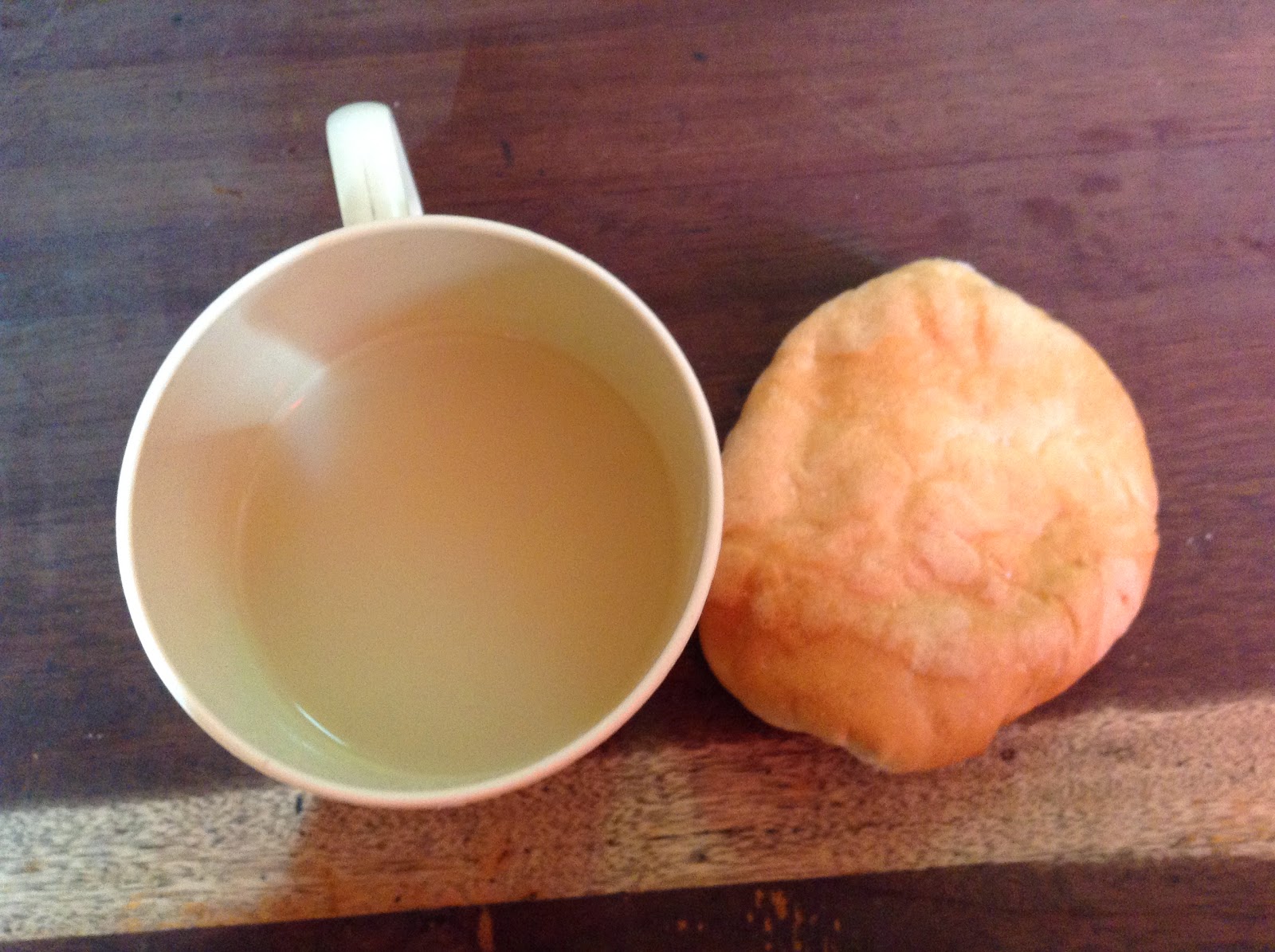
Bolivians really like food - they take a lot of pride in it, and they seem to eat all day long.  Even at the orphanage, where the food isn't exactly gourmet, we eat every few hours.  The girls have breakfast before I get there, but around 10:00 every morning, we stop to have a morning snack.  Usually, it's exactly what's shown on the left: tea and a roll that looks like a hamburger bun. 

Lunch is around 12:00 for the older girls and 1:00 for the younger girls.  It's the biggest meal of the day, and usually includes a few different parts - a salad and plate of rice, potatoes, and meat, for example, or a bowl of vegetable soup followed by a bowl of lentils.  The picture on the right is pretty standard - a cucumber and tomato salad with rice and a potato, meat, and vegetable stew.  I have never had a meal there that did not include potatoes, and often they make more than appearance (such as in the soup and then boiled with the main plate).  There is also always a dessert, usually a slice of pineapple, half a banana, or an orange, but sometimes a little cup of pudding or Jello.

Then, around 4:00, we have an afternoon snack - usually another roll with a hot drink (Bolivians also love carbs).  Sometimes the drinks are things I recognize, like hot chocolate or tea, and sometimes they are more unique.  We had arroz con leche one day - a little bit of rice boiled with cinnamon and cloves, with sugar and powdered milk mixed in.  (That's a picture of it to the left).  It was a little strange to be drinking rice, but it was creamy and sweet and good!  We've also had similar drinks, made with all of the same ingredients but with oatmeal or groud corn instead of the rice.

I've been making dinner on my own, but from what I can tell, most Bolivians don't eat much for that meal.  (Lunch is a bigger meal, plus they do snack a lot.)  I think at the orphanage, they usually have a little soup, and other people have told me they usually just have a roll with some cheese or something light like that.

Tuesday, September 9, 2014

¡Estoy aquí!


Hello, all!  I've been in Cochabamba for almost two weeks now, but have had a little trouble finding wifi.  Now that I know the city a little better, though, I should be able to post more often.


I thought I'd start by posting some pictures of the city of Cochabamba.  It's unlike any city I've seen before.  For one thing, it's completely surrounded on all sides by mountains, so anywhere you look, at the end of every road, you can see them.  I love that.

Also, there are flowers everywhere - in almost every tree, in private gardens, and in the many parks that there are here.  Even though the city is huge and developed, people make sure there are plenty of plants and green spaces, which is awesome, especially in the spring (which we're in now).  The weather is also perfect - almost always sunny and 70-80 degrees in the day, and 50ish degrees at night.  You need a llama blanket or two, but no heat or air-conditioning.